How to Source Private Label Press-On Nails from China: An Expert OEM/ODM Guide
Press-on nails have become a scalable, repeat-purchase product across Amazon, TikTok Shop, and DTC brands. Their fast design cycles and relatively低 entry barrier make them attractive for private label launches, but sourcing mistakes often show up quickly through returns and negative reviews. According to data published by Fortune Business Insights, the global artificial nails market was valued at about USD 1.6 billion and is expected to grow steadily, supported by rising at-home beauty consumption and the influence of social commerce.
The choice of press-on nails manufacturer affects far more than cost. Fit consistency, surface finish, packaging durability, and adhesion expectations all influence how the product performs after launch. These issues are easy to overlook when brands move into production without a clear sourcing framework.
This guide focuses on how to source custom press-on nails through the right OEM or ODM supplier, including realistic MOQ expectations, sample evaluation, and quality control planning. The goal is to help brands work with a press-on nails supplier that can support consistent quality, stable reorders, and long-term growth.
Why Press-on Nails Work for eCommerce, and Where Brands Get Burned
Press-on nails fit naturally into today’s eCommerce model. They are lightweight, easy to ship, visually driven, and highly responsive to trends. New styles can be launched quickly, creators can drive sudden demand, and customers are willing to repurchase when fit and wear experience meet expectations. For private label brands, this makes press-on nails a flexible product with strong repeat potential.
The problem is that many sourcing issues only appear after the product goes live. Inconsistent sizing across sets leads to poor fit. Uneven surface finishing or weak shine shows up immediately on camera and in user photos. Packaging that looks fine in samples may fail during shipping, resulting in scratched nails or broken trays. Adhesion complaints often stem from unclear positioning of glue versus adhesive tabs, rather than the product itself.
Because press-on nails are judged almost instantly by look, comfort, and durability, small manufacturing flaws translate directly into returns and review damage. This is why brands sourcing press-on nails need to think beyond design and price, and treat manufacturing quality, packaging, and consistency as part of their go-to-market strategy, not a post-launch fix.
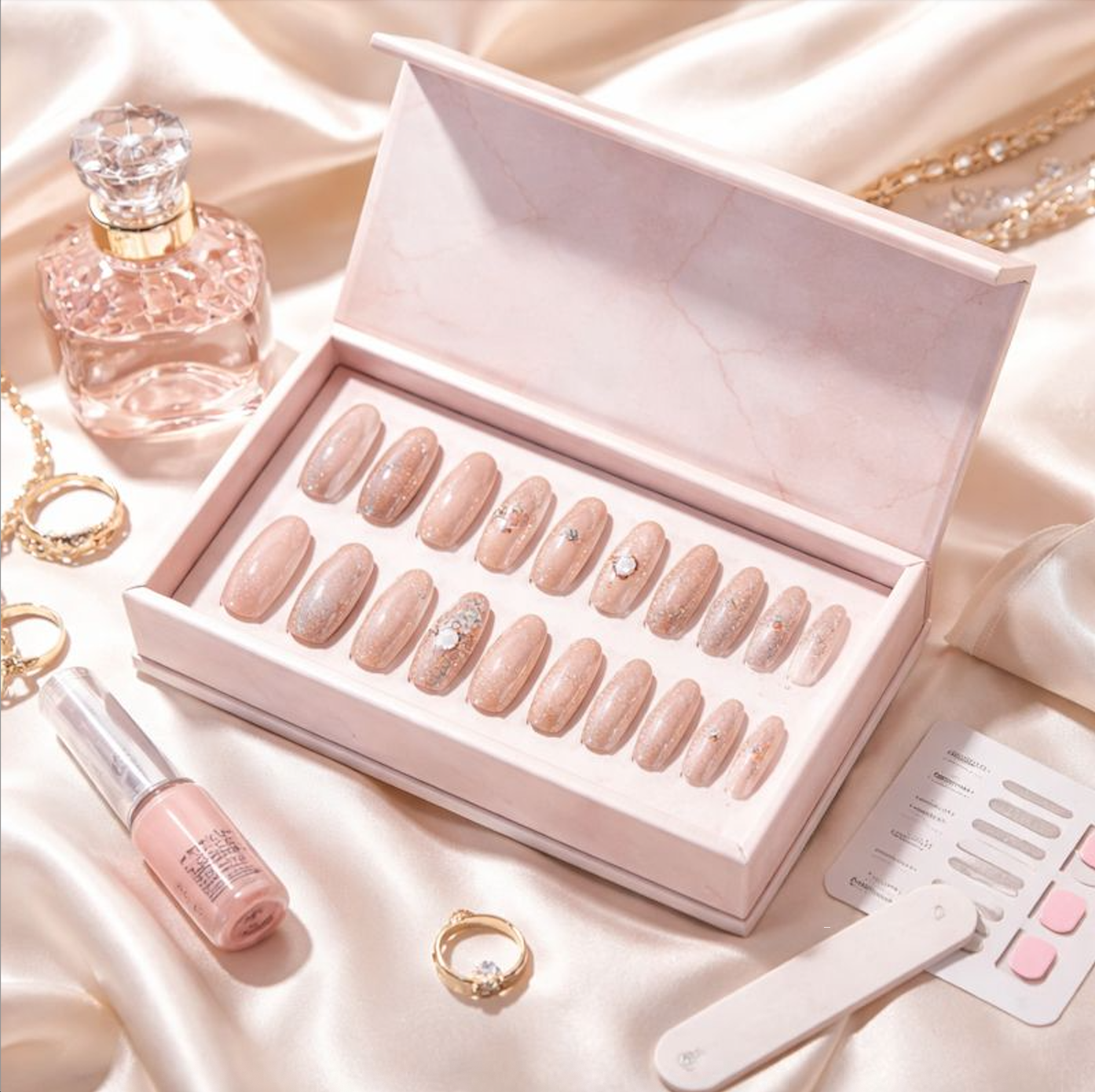
OEM vs ODM for Press-on Nails: What Actually Changes for Brands
When sourcing press-on nails, the choice between OEM and ODM affects development speed, cost structure, and how much control a brand has over the final product. Understanding this difference early helps avoid misaligned expectations with a manufacturer.
OEM sourcing means the brand provides its own designs, specifications, or style references, while the factory focuses on production. This route offers greater control over shapes, finishes, sizing profiles, and packaging details, but usually requires more development time and clearer technical briefs. OEM is often better suited for brands that already understand their customer preferences and want to build a distinct product identity.
ODM sourcing relies on the manufacturer’s existing designs or base models, with limited customization applied to colors, finishes, or branding. For new brands or test launches, ODM can shorten lead times and reduce development risk. However, differentiation is more limited, and brands should be clear about how widely those designs are already used.
In practice, many press-on nails suppliers operate with a hybrid approach, offering ODM styles that can gradually be customized through OEM adjustments. The key is aligning the sourcing model with your launch goals, timeline, and ability to manage sampling and revisions before moving into bulk production.
What Quality Really Means in Press-on Nails Manufacturing
Quality in press-on nails goes beyond how the product looks in a sample photo. From a manufacturing and sourcing perspective, it should be defined through clear, repeatable checkpoints that directly affect user experience and reviews.
- Fit and sizing consistency: Each set should maintain stable width, curvature, and thickness across all sizes. Inconsistent sizing leads to poor fit, lifting, and comfort issues, even when the design itself looks correct.
- Thickness and structure: Nails that are too thin feel flimsy and break easily, while overly thick nails look unnatural and feel uncomfortable. A balanced thickness profile is essential for durability and wear comfort.
- Surface finishing quality
Coating should be even and clean, without dust particles, bubbles, or patchy shine. These defects become highly visible under close-up photos and video content. - Edge finishing: Poorly trimmed edges snag on hair and fabric, which users notice immediately. Clean, smooth edges are a basic but often overlooked quality indicator.
- Packaging protection: Trays and inserts should prevent movement during shipping. Weak packaging often results in scratched surfaces or cracked nails before the product is used.
Experienced press-on nails manufacturers such as Ennio typically manage these factors as a single production system rather than isolated steps, ensuring that approved samples can be reproduced consistently at scale.
Typical MOQ, Lead Time, And What “MOQ” Really Includes
MOQ is often presented as a single figure, but in press-on nails manufacturing it usually consists of several different minimums. Understanding these numbers early helps brands plan test runs without locking themselves into unnecessary volume.
- Product MOQ: For existing ODM designs, many press-on nails suppliers accept test orders starting from around 500 to 1,000 sets per design. Fully custom OEM designs often start at 2,000 to 5,000 sets, depending on shape complexity, finish type, and color matching requirements.
- Packaging MOQ: Custom packaging almost always has a higher minimum. Printed boxes and inserts commonly start at 2,000 to 3,000 units per design, even if the nail sets themselves can be produced in smaller quantities. This is one of the main reasons brands choose neutral packaging for initial launches.
- Sampling Timeline: Sample production typically takes 10 to 20 days. If revisions are needed, each additional round may add another 7 to 10 days, especially when adjusting curvature, thickness, or surface finish.
- Bulk Production Lead Time: After sample approval, bulk production usually requires 20 to 35 days, depending on order size and factory schedule. High season or large-volume orders may extend this timeline.
Breaking MOQ and lead time into these components allows brands to test the market more efficiently while keeping cash flow and launch schedules under control.
The Sourcing Workflow That Prevents Costly Mistakes
A structured sourcing workflow separates brands that scale smoothly from those that struggle with inconsistent quality and delayed reorders. Press-on nails sourcing should be managed as a repeatable process with clear decision points, not as a one-off purchase.
- Define Product Positioning Early: Decide whether the product targets mass market, mid-range, or premium buyers. This affects material choice, finish standards, packaging, and acceptable cost ranges.
- Prepare A Clear Specification Brief: Outline target shapes, sizes, thickness, finish types, and kit contents. Clear specifications reduce misunderstandings and unnecessary sample revisions.
- Shortlist Qualified Suppliers: Focus on press-on nails manufacturers with established OEM or ODM workflows, stable capacity, and experience handling private label orders.
- Conduct Structured Sampling: Evaluate samples based on fit, surface quality, edge finishing, and packaging protection, not appearance alone. Document feedback clearly for each revision.
- Approve A Golden Sample: Lock a final approved sample once expectations are met. This golden sample becomes the reference point for bulk production and quality checks.
- Set Quality Control Checkpoints: Include inspections during production and final checks before shipment to identify sizing drift, surface defects, or packaging issues early.
What To Request In A Press-On Nails Sample Kit
Structuring the sample kit this way helps brands evaluate both product performance and shipping readiness before approving bulk production.
Product Samples And Fit Evaluation
- Full size range used in production, not only the most common sizes
- Separate samples for each planned shape to check curvature and comfort
- Two to three finish types, such as solid color, cat eye, or glaze, to compare surface consistency
- Thickness balance that supports durability without feeling bulky
- Adhesion options, including adhesive tabs and glue, if both will be offered to customers
Packaging And Production Details
- Actual inner trays and inserts used for shipping to assess movement and scratch risk
- Outer packaging strength to prevent breakage during transport
- Material information and basic size charts for internal reference
- Notes on finishing process and coating method to support future reorders
Platform-Specific Sourcing Considerations
Press-on nails may look like the same product across channels, but platform dynamics change how sourcing decisions should be made. Brands that ignore these differences often face avoidable issues after launch. Aligning sourcing decisions with platform behavior helps brands avoid mismatches between manufacturing setup and sales channel expectations.
Amazon And Marketplaces
- Return Tolerance: Amazon customers are less forgiving of fit or packaging issues. Sizing consistency and protective packaging are critical to control return rates.
- Claim Discipline: Product descriptions should match real-world wear experience. Overstated durability or adhesion claims often lead to negative reviews.
- Batch Consistency: Small quality shifts between production batches are quickly reflected in reviews. Stable QC processes matter more than visual differentiation.
TikTok Shop And Creator-Led Sales
- Visual Finish Quality: Surface defects are amplified on video. Even minor dust or uneven shine becomes obvious in close-up shots.
- Demand Spikes: Viral content can create sudden order volume. Working with a press-on nails supplier that can scale production without quality drop is essential.
- Fast Iteration: Trend cycles are short. ODM-based launches with quick customization often perform better for early testing.
Shopify And DTC Brand Sites
- Brand Cohesion: Packaging, inserts, and overall presentation influence brand perception more heavily than on marketplaces.
- Repeat Purchase Experience: Comfort, durability, and ease of use drive long-term value. These factors should be validated during sampling, not after launch.

A Buyer’s Checklist For Choosing A Press-On Nails Manufacturer
Selecting the right press-on nails manufacturer is less about finding the lowest price and more about choosing a partner that can support consistent quality as your brand scales. Before committing to bulk production, brands should review suppliers against a clear set of criteria.
- Clear OEM And ODM Capabilities: The manufacturer should be able to explain how they handle both OEM and ODM projects, including what can be customized and at what stage.
- Stable Production Capacity: Consistent output matters more than maximum volume. A reliable press-on nails supplier should demonstrate the ability to maintain quality across repeat orders.
- Defined Quality Control Process: Look for documented checks during production and before shipment, rather than relying on final inspection alone.
- Transparent MOQ And Lead Time Structure: Product MOQ, packaging MOQ, and production timelines should be clearly separated and explained upfront.
- Sampling And Revision Support: The supplier should allow structured sampling and feedback rounds, not rush brands into bulk orders.
- Packaging And Fulfillment Experience: Experience with export packaging, labeling, and shipping reduces the risk of damage and compliance issues.
- Communication And Responsiveness: Clear, timely communication during sampling and production is often a better indicator of long-term reliability than pricing.
Using this checklist helps brands narrow down press-on nails manufacturers that are suitable for private label growth rather than short-term sourcing.
Final Notes And How To Get Started
If you are planning to source press-on nails and want to move from research into execution, the next step is to start a structured conversation. Clear requirements, proper sampling, and early quality checks make a significant difference to how smoothly a product launches and scales.
If you need support with supplier sourcing, sample coordination, or quality control, you can contact Here Fashion Hub to discuss your project and sourcing goals. For brands that already have clear specifications and are ready to work directly with an experienced OEM or ODM press-on nails manufacturer, reaching out early helps align timelines, MOQs, and production expectations from the start.
Taking the time to speak with the right partners now can prevent costly revisions later and set a stronger foundation for long-term growth.


